
What is learning?
If we use the word ‘learning’ everyday without a problem, why are there such acrimonious disagreements about what it means?


A condensed version of this post first appeared in TES on 17th December 2025.
Why is it that, in my twenty-odd years of teaching, the conception of learning has shifted from ‘market stalls’ and ‘discovery’ to ‘retrieval practice’ and ‘change in long-term memory’? Is it really because we’ve finally discovered what learning really is?
‘Standardisation’ of learning
Concepts like learning and knowledge are to education what weights and measures are to the marketplace.
Concepts, weights, and measures are tools we use to compare, classify, discriminate and so on.
Just as weights and measures are made of various materials structured in particular ways, an idea is made of words, gestures or images structured in particular ways.
And just as the standardisation of weights and measures is central to a just and accountable marketplace, so is the standardisation of our concepts central to a just and accountable education system.
Now, sometimes this standardisation occurs consciously, for example, as a result of academic commitments (Ofsted citing Sweller et al.: “If nothing is altered[sic.] in long-term memory, nothing has been learned.”) Or else it can occur as a side-effect of accountability measures, which often narrow the de facto meaning of ‘learning’ to ‘what tests can measure’.
Are students being short-weighted?
However, if I think my children aren’t learning (or are doing so only in a very narrow sense) I wouldn’t be happy with the reply, ‘ah–but we’ve redefined learning as x, which is exactly what your children are doing, so they are learning’; just as I wouldn’t be happy if I were told, ‘well we’ve redefined 1kg to be half of what it was, so you have got 1kg of flour!’
Given we want children to learn in the sense we’ve always understood it, any standardisations and policies should reflect our ordinary use.
Therefore, we don’t just need to be able to use the word ‘learning’, we also need to understand how the idea is constructed, what patterns of words can and can’t express the idea. And as Gilbert Ryle wrote, it’s one thing to know one’s way about town, quite another to draw a decent map of it.
So… we have two questions: how do we go about reverse-engineering a concept like learning, and does the education we provide align with that concept?
Can we define learning by thought alone?
Some believe we can boil learning down to its essential properties. According to one kind of essentialism (often called Platonism) ideas are somehow built-in to the universe, and independent of our language. So to find out what learning really is, we need to come up with a kind of checklist of necessary and sufficient conditions.
Most concepts, however, aren’t definable in this way. We don’t teach most words by giving checklists of conditions, instead we might point at a sample, or give a load of examples (and non-examples), or we might paraphrase a sentence, or by explaining what it doesn’t mean and so on.
And they’re also far messier. So defining learning like this turns into a tiresome game of ‘hunt-the-counter-example’: if, for example, someone says ‘learning is a change in long-term memory’, we can point out that a car crash might lead to a change in long-term memory but isn’t learning (so the conditions aren’t sufficient) and I can learn something but quickly forget it (so the conditions aren’t necessary).
Can science define learning?
Some think we can discover the essence of learning through observation and experiment. As Daniel Willingham has written, “don’t we expect that a good definition of learning might be the result of research, rather than a prerequisite?” Can’t we simply see what different examples of learning have in common and build our checklist of conditions from there?
For instance, the claim that “If nothing has changed in long-term memory, nothing has been learned” is offered not as a stipulative definition, but as a discovery grounded in research on memory, schema theory, and schema acquisition.
Unfortunately, these ‘discoveries’ of empirical or a posteriori essentialism are entirely circular, since any act of selecting samples of ‘learning’ for investigation presupposes a definition of learning.
Scientists might respond, however, that we have discovered what things are—water is H₂O, species are defined by DNA—and that science corrects old definitions, from reclassifying whales as mammals to correcting the idea that learning is ‘feeling like you’ve understood’.
Is it all just about theory?
And following WVO Quine, some would push this further and argue that all ‘conceptualisation’ is theory, that there is no meaningful distinction between descriptions and definitions—both are part of our theories of the world.
But whilst it’s true that ‘This child has learnt X’, could be a description of ‘this child’, or an example/explanation of ‘has learnt X’, it can’t do both jobs simultaneously, since describing the child as ‘having learnt X’ presupposes the person I’m talking to doesn’t need a definition.
As PMS Hacker points out, there are two quite distinct questions, the answers to which have different roles to play:
Firstly, there’s the conceptual question: ‘What sorts of things do we call ‘learning’?’ This is about the concept we use to classify, order, and compare our educational activities and aims.
Secondly, science, by contrast, is concerned with empirical questions regarding those things so defined: What will happen if I use mini-whiteboards rather than Kahoot? What’s the quickest, cheapest, or most efficient way to raise our P8?
Don’t confuse the measuring tool with the thing being measured
Of course science constructs, adapts and revises new technical concepts to examine phenomena. But we mustn’t confuse the concept that identifies what we’re investigating (i.e. learning), with the technical concepts and theories we develop to study it. Changing the criteria by which we identify the object of inquiry changes it—a mistake Wittgenstein likened to sawing off the branch on which you’re sitting.
Hence, yes, chemists discovered regularities relating water to hydrogen and oxygen, but it was a decision to transform these discoveries into a technical rule excluding anything other than H2O from being called ‘pure water’, and these results didn’t redefine water since ‘water’ was what they were investigating.
And so, Willingham’s contention that the definition of learning might be the result of research rather than a prerequisite, simply doesn’t make any sense.
A WIttgensteinian approach: “don’t think, but look!”
Good educational policy requires a conceptual map of this concept, how this tool is constructed, the patterns of words that can (and can’t) express the idea of learning.
And we do this, not by thinking, hypothesising, and theorising, or plucking notions out of the air, but by looking at how we actually use the words which express the idea in real life: what does this idea imply, exclude, rebut, suggest, support? If something is one thing, can/must it also be this other thing? Can it be qualified like this? And so on.
“A one-sided diet”
“A main cause of philosophical diseases”, wrote Wittgenstein, is “a one-sided diet: one nourishes one’s thinking with only one kind of example.”
We can often substitute the word ‘learning’ for ‘memorising’ or ‘practicing’: ‘I am learning my lines for the play/times tables/French verbs’.
But there are also many other uses of the word learning which cannot be reduced like this:
‘I learned an important lesson today’, can’t be switched with ‘I memorised an important lesson today’; nor can ‘I learned that she didn’t go after all’; or ‘I learned the value of friendship’; or ‘I learned the truth’.
So let’s take a broader range of examples. In each of the following sentences, the main verb could be replaced by to learn:
I discovered that she wasn’t Greek
I have memorised this poem
I noticed that each time this happened, that happened
I became aware of her jealous streak: I learned of
I am practicing the piano
I am looking up how to answer this question
I am thinking about the Civil War
I am rehearsing my lines
I am imagining potential solutions (perhaps would have to be ‘learning about’ here).
(It’s also clear from this list that ‘discovering’ isn’t synonymous with all these examples.)
This list is by no means exhaustive, but we can begin to see some patterns and logical distinctions.
Learning as a result or an activity
Sometimes (normally in the past tense) the word learning is used to describe a result (that some knowledge/skill has been acquired), and sometimes it is used to describe an activity (the act of acquiring).
We can differentiate between result and activity uses because it would be pleonastic to say someone successfully discovered something (result), but not successfully looked something up (activity).
I can achieve results repeatedly, or gradually, but not continuously. Hence, activities can have a progressive form but results tend not to. It’d be odd to say ‘I am discovering that she wasn’t Greek’, as if it were some kind of ongoing process (though we might memorise a poem bit-by-bit).
Learning as a result
Learning-as-result words can indicate that something’s been achieved or attained (things we can try to do) like ‘discover’, ‘discern’, ‘memorise’, ‘hear’, ‘see’, ‘read’, ‘understood’, and so on, or they can indicate that something’s been received (something we can’t try to do) like ‘notice’, ‘realise’ or ‘become aware of’.
There’re also ethical or axiological learning-as-results, for example, ‘she has learnt to not interrupt/be brave/speak her mind’ and so on. This can refer to an attainment, ‘she has cultivated/developed a disposition to be brave’; or a reception, ‘she has realised why it is important to not interrupt’. (But note that just because you can try to understand something, understanding isn’t always the result of trying.)
And there can also be emotional aspects to results, I can be surprised that…, shocked that…, fascinated by the fact that… horrified by the fact that… and so on (which can be attainments or receptions).
And then we can further differentiate four kinds of learning activities:
Searching activities like looking up, looking for, listening for, searching for. These activities are completed when a particular piece of information has been found.
Training activities differ insofar as their end is an ability to do something. If, for example, we are rehearsing our lines, the aim is to be able to recite them at will.
Contemplative activities are things like listening to, looking at, contemplating, paying attention, and thinking about. In contrast to training and searching activities, contemplative activities have no specific end in mind (though they are done for reasons).
Productive or generative activities are those that involve thinking up possibilities, imagining, coming up with, and so on. They have no specific end in mind, but unlike contemplative activities, they are productive rather than attentive.
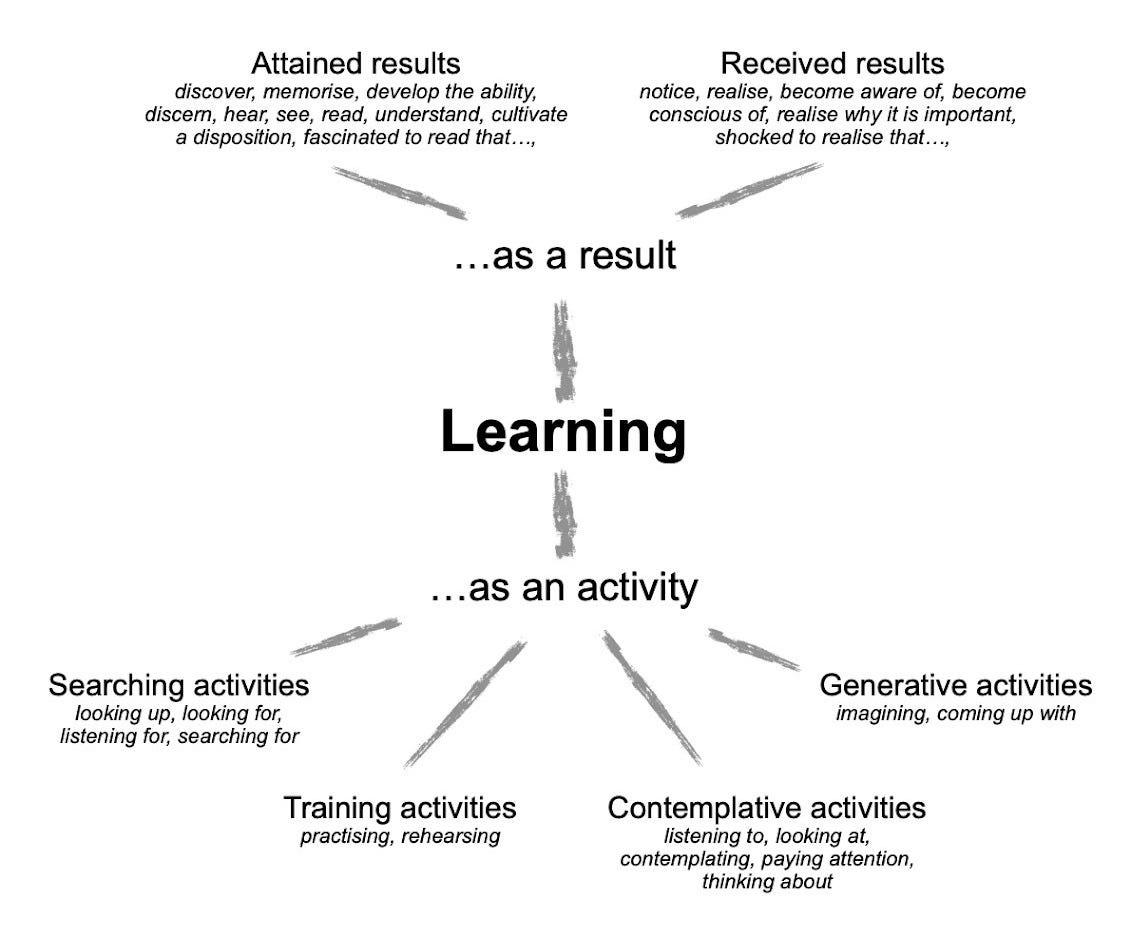
So using this map, we can now ask whether we focus on training activities (like practice testing) at the expense of contemplative or searching ones (open discussions or navigating the internet). Or whether we focus on learning-as-attainment (e.g. developing abilities) rather than learning-as-reception (e.g. opportunities for students to realise, notice things)? I remember going on a trip to the beach and lots of children had never played in sand, never felt it run through their fingers. It wasn’t on the exam, but an important learning experience nonetheless.
How does our system match up?
Much of the new government’s work aligns well with this broader map of learning. The SMSC section of Ofsted’s toolkit, for instance, highlights students’ “fascination in learning” and their engagement with artistic, musical, sporting and cultural opportunities.
The Francis review’s call to cut exam time by 10% and “go further where possible” is also welcome as a means to free up curriculum time for activities beyond training for exams.
Likewise, the government’s proposed core enrichment entitlement, guaranteeing all pupils access to civic engagement, arts and culture, nature and adventure, and sport, signals a shift toward a richer conception of learning.
I would like to see them go further and embed the full concept of learning in law. The 2002 Education act requires schools to provide a “balanced and broadly based curriculum which—
promotes the spiritual, moral, cultural, mental and physical development of pupils at the school and of society, and
prepares pupils at the school for the opportunities, responsibilities and experiences of later life.”
I would add a third: “provides opportunities for learning in all its forms” or something similar.
Such a commitment should be supported by protected time each week for kinds of learning that are not easily measured or directly tied to grades—especially those that cultivate receptivity: noticing, realising and related capacities, or those that involve contemplation rather than practicing.
The new enrichment entitlement will help, but schools also need space for the open (and I would add unassessed) conversations advocated by Peter Hyman. And if we take media literacy seriously, students must have time for exploratory searching—particularly online research. It is an inefficient way to acquire examinable knowledge, but an essential skill to foster.
And finally, whilst I agree that teaching should be evidence-informed, phrases in the toolkit such as “prioritise feedback, retrieval practice and assessment” risk narrowing the definition of learning. We should remain cautious about scientific overreach.
Conclusions
Education is an area of policy where enormous changes can occur at relatively little immediate financial cost, and the effects of those changes won’t be seen for years. As such, it is highly susceptible to big swings in vision. The Francis review was right to advocate “evolution rather than revolution”.
Education policy, therefore, needs ballast to keep it steady against the winds of opinion. That ballast can’t be science alone, since the questions to which we require answers aren’t merely empirical, nor can it simply be performances in tests and tables like PISA or P8, as there are things that are more valuable than grades.
Instead, a stable, broad, and ordinary understanding of “learning” must therefore anchor educational policy, or we risk letting our instruments remake the landscape they were designed to measure.